AISC Steel Construction Manual 16th Edition: A Comprehensive Overview

The AISC Steel Construction Manual’s 16th edition delivers crucial specifications and codes for safe, efficient steel building design, partnering with the AEC community.
The AISC Steel Construction Manual stands as the definitive resource for structural steel design, offering comprehensive guidance to architects, engineers, and construction professionals. This manual, developed by the American Institute of Steel Construction (AISC), a not-for-profit technical institute, embodies a commitment to safety and efficiency in steel construction.
It consolidates essential specifications, codes, and design aids, streamlining the design process and ensuring compliance with industry standards. The manual serves as a vital link between theoretical principles and practical application, facilitating the creation of robust and reliable steel structures. AISC actively collaborates with the AEC community to continually refine and update the manual, reflecting the latest advancements and best practices in the field. It’s a cornerstone for anyone involved in fabricated steel buildings and bridges.
Historical Context and Evolution of the Manual
The AISC Steel Construction Manual’s evolution mirrors the advancements in structural steel technology and construction practices. Beginning in 1873, AISC has meticulously recorded structural steel shape dimensions and properties, building a comprehensive historical database. Early editions focused on basic design principles and material properties, gradually expanding to incorporate more sophisticated analysis methods and safety factors.
Over decades, the manual adapted to evolving codes and standards, notably the introduction of Load and Resistance Factor Design (LRFD). Each edition reflects a commitment to improving design reliability and promoting innovation. The current 16th edition builds upon this legacy, integrating the 2022 AISC Specification and Code of Standard Practice, ensuring it remains a relevant and indispensable tool for the industry.
AISC’s Role in Steel Construction Standards
AISC, as a not-for-profit technical institute, plays a pivotal role in developing and maintaining steel construction standards. It actively partners with the architecture, engineering, and construction (AEC) community to create safe and efficient specifications and codes. The AISC Specification establishes generally applicable requirements for designing and constructing steel buildings and structures, with the 2022 edition being the latest iteration.
Furthermore, AISC’s Code of Standard Practice (ANSI/AISC 303-22) sets quality benchmarks for the industry. AISC also offers Quality Management Systems (QMS) Certification programs, ensuring structural steel fabrication meets rigorous standards. Through extensive publications and the AISC Learning Portal, they disseminate knowledge and promote best practices within the steel construction sector.
Key Components of the 16th Edition
The 16th edition features the 2022 AISC Specification, the ANSI/AISC 303-22 Code of Standard Practice, and AISC Quality Management Systems (QMS) Certification details.
The 2022 AISC Specification for Structural Steel Buildings
The 2022 AISC Specification represents the foundational requirements for designing and constructing steel structures, encompassing buildings and various other applications. This edition serves as an update, superseding previous versions and incorporating the latest advancements in steel construction technology and research.
It provides a comprehensive framework for engineers and designers, outlining acceptable practices and ensuring structural integrity. The specification details material properties, design methodologies, and safety factors crucial for reliable performance.
Key areas covered include member design, connection design, and stability considerations. It’s a vital resource for professionals involved in all phases of steel construction, promoting safety and efficiency within the industry. Access to the specification ensures adherence to current best practices and regulatory standards.
Code of Standard Practice for Steel Buildings and Bridges (ANSI/AISC 303-22)
Part 16.3 of the AISC Manual is dedicated to the 2022 Code of Standard Practice (ANSI/AISC 303-22), a crucial document outlining requirements for fabrication, erection, and overall quality control in steel construction. This code establishes minimum standards for all parties involved – fabricators, erectors, and designers – ensuring consistent and reliable outcomes.
It covers aspects like material traceability, welding procedures, bolting techniques, and dimensional tolerances. Adherence to this code minimizes risks and promotes a higher level of workmanship.
The ANSI/AISC 303-22 code is essential for maintaining the integrity and longevity of steel structures, bridging the gap between design intent and actual construction. It’s a cornerstone of quality assurance in the steel industry.
AISC Quality Management Systems (QMS) Certification
AISC’s Quality Management Systems (QMS) Certification programs represent the gold standard for quality within the structural steel industry. These certifications aren’t merely badges; they signify a commitment to rigorous quality control and consistent performance throughout fabrication and erection processes.
AISC offers various QMS certifications, each tailored to specific aspects of steel construction. Achieving certification demonstrates a company’s dedication to meeting – and exceeding – industry best practices.
These programs enhance project reliability, reduce potential issues, and instill confidence in clients. QMS certification is a valuable asset, showcasing a firm’s dedication to delivering high-quality steel structures.

Design Aids and Tables
The manual provides essential design aids and tables, including available strengths, geometric conditions, and a comprehensive database of steel shape dimensions and properties.
Available Strengths and Geometric Conditions
AISC’s manual meticulously details available strengths for various steel members, crucial for accurate structural design. These strengths are not universal; they are intrinsically linked to specific geometric conditions. The 16th edition’s tables clearly delineate these relationships, ensuring engineers can select appropriate values based on member shape, size, and configuration.
These tables are developed using limits states defined within the 2016 AISC Specification for Structural Steel. Understanding these geometric limitations is paramount, as exceeding them can compromise structural integrity. The manual provides a systematic approach to determining available strengths, considering factors like slenderness ratios and unbraced lengths. This detailed presentation facilitates compliant and safe designs, minimizing potential risks in steel construction projects.
Engineers can confidently navigate complex calculations with the aid of these comprehensive tables, streamlining the design process and promoting efficient use of materials.
Structural Steel Shape Dimensions and Properties Database
The AISC maintains an extensive database compiling structural steel shape dimensions and properties, a cornerstone resource for engineers. This invaluable compilation spans from 1873 to 2016, offering a historical record of steel section evolution. It’s more than just a catalog; it’s a comprehensive archive detailing changes in manufacturing and material characteristics over time.
This database provides critical information like section moduli, areas, and radii of gyration, essential for stress and deflection calculations. Access to this data allows for precise analysis and design of steel structures, ensuring optimal performance and safety. The database facilitates accurate modeling and simulation, reducing the need for manual calculations.
Engineers can leverage this historical data for retrofit projects or when working with older structures, ensuring compatibility and structural integrity.
Connection Design Provisions
The AISC Steel Construction Manual’s 16th edition provides detailed provisions for designing robust and reliable steel connections. These provisions cover a wide array of connection types, including bolted, welded, and shear connections, ensuring structural integrity. The manual offers guidance on calculating connection capacities, considering factors like bolt shear, bearing, and tension.
Designers will find comprehensive tables and formulas for determining the strength of various connection configurations, streamlining the design process. The provisions address both serviceability and strength limit states, ensuring long-term performance and safety. Detailed examples illustrate practical application of the design rules.
These provisions are crucial for transferring loads effectively between steel members, vital for overall structural stability.

Load and Resistance Factor Design (LRFD)
The 16th edition’s LRFD methodology utilizes load combinations and resistance factors to ensure safe and reliable steel structure designs, per AISC specifications.
LRFD Methodology in the 16th Edition
The 2022 AISC Specification fundamentally employs Load and Resistance Factor Design (LRFD) as its primary design philosophy. This methodology represents a significant advancement over Allowable Strength Design, focusing on probabilistic approaches to structural safety.
LRFD achieves safety by applying resistance factors (Φ) to the nominal strength of structural members, reducing it to a design strength. Simultaneously, load factors (γ) are applied to anticipated loads, increasing their magnitude.
This dual factoring process accounts for uncertainties in both material properties, fabrication, and the accuracy of load estimations. The 16th edition refines these factors based on extensive research and practical experience, ensuring a consistent and reliable level of safety. The specification details specific factors for various limit states, including strength, serviceability, and fatigue.
Ultimately, LRFD in the latest AISC manual provides a more rational and efficient design approach, optimizing material usage while maintaining structural integrity.
Load Combinations and Factors
The AISC Specification meticulously defines load combinations and associated factors crucial for structural steel design. These combinations represent realistic scenarios of loads a structure might encounter during its lifespan, considering various possibilities.
Load factors, denoted by γ, amplify each load type – dead, live, roof live, snow, rain, wind, earthquake, and others – to account for uncertainties in their magnitude. The 16th edition provides updated load factors reflecting current understanding and research.
These factors are applied to nominal loads to determine factored loads, which are then used in conjunction with resistance factors in the LRFD methodology.
The manual details numerous load combinations, each representing a specific loading scenario. Proper selection and application of these combinations are vital for ensuring structural safety and serviceability under all anticipated conditions.
Resistance Factors for Steel Members
The AISC Specification establishes resistance factors (Φ) that reduce the nominal strength of steel members to account for uncertainties in material properties, fabrication, and construction. These factors are integral to the Load and Resistance Factor Design (LRFD) methodology.
Φ values vary depending on the limit state being considered – yielding, buckling, fracture, or fatigue – and the type of steel member (rolled shapes, welded sections, etc.). The 16th edition presents updated resistance factors based on extensive research and statistical analysis.
Applying these factors ensures a reliable margin of safety, preventing structural failure under extreme loading conditions.
The manual provides comprehensive tables detailing resistance factors for various member types and limit states, guiding engineers in accurate and safe design calculations.

Specific Design Considerations
The 16th edition addresses critical aspects like buckling, shear, and fatigue, offering detailed guidance for robust and reliable steel structure designs.
Buckling Strength of Steel Members
Buckling is a paramount concern in steel design, and the 16th edition of the AISC Steel Construction Manual provides comprehensive provisions for assessing and mitigating this potential failure mode. The manual details methods for calculating the critical buckling loads of various steel members, including columns, beams, and plates, considering factors like material properties, geometry, and end conditions.
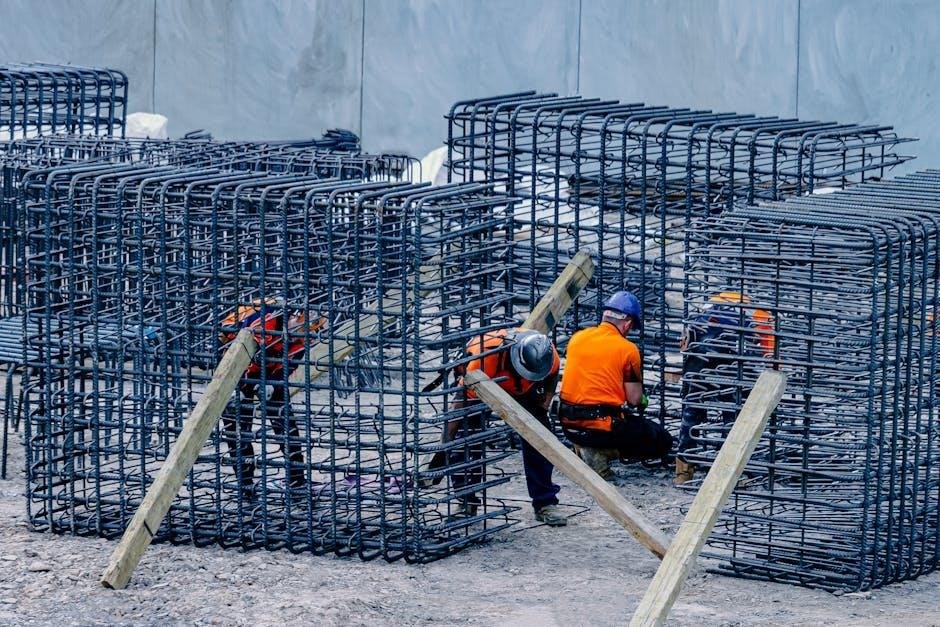
It outlines procedures for determining effective lengths, which account for the support conditions and influence the buckling capacity. The specification incorporates both elastic and inelastic buckling analyses, offering designers the tools to accurately predict member behavior under compressive loads. Furthermore, the manual addresses local buckling phenomena, which can occur in thin-walled sections, and provides guidance on incorporating these effects into the design process. Understanding these provisions is crucial for ensuring the stability and safety of steel structures.
Shear Strength and Design
The AISC Steel Construction Manual’s 16th edition dedicates significant attention to shear strength and design, recognizing its critical role in structural integrity. It provides detailed provisions for calculating the shear capacity of steel members, encompassing both yielding and buckling shear failures. The manual differentiates between various member shapes – rolled shapes, welded shapes, and plates – offering specific equations and guidelines for each.
Designers can find guidance on shear lag, a phenomenon where shear stresses are not uniformly distributed across the cross-section, and how to account for its effects. The specification also addresses the interaction between shear and bending, ensuring a comprehensive assessment of member capacity. Provisions for shear connections, such as bolted and welded joints, are also included, enabling safe and efficient transfer of shear forces. Accurate shear design is vital for preventing brittle failures and ensuring structural robustness.
Fatigue Design of Steel Structures
The 16th edition AISC Steel Construction Manual comprehensively addresses fatigue design, crucial for structures subjected to cyclic loading – like bridges and crane support systems. It details methods for evaluating fatigue resistance, considering stress range, mean stress, and weld details. The manual provides S-N curves (stress versus number of cycles to failure) for various steel grades and connection types, enabling accurate fatigue life predictions.
Designers will find guidance on categorizing stress ranges and applying appropriate fatigue reduction factors. The specification emphasizes the importance of detailing to minimize stress concentrations, which accelerate fatigue crack initiation. It also covers inspection and repair strategies for fatigue-prone areas. Proper fatigue design ensures long-term structural reliability and prevents catastrophic failures due to repeated loading.
Resources and Learning Materials
AISC offers extensive learning portals, free downloads, and publications supporting steel design and construction, including historic standards for comprehensive educational access.
AISC Learning Portal and Educational Resources
The AISC Learning Portal stands as the premier resource for in-depth information regarding steel design and construction. It provides a variety of convenient learning formats, catering to diverse educational preferences. Whether you’re a seasoned professional or just beginning your journey in structural steel, the portal offers valuable content.
Users can access courses, webinars, and technical resources designed to enhance their understanding of the AISC Steel Construction Manual and related standards. The portal aims to build expertise in applying these standards effectively. It’s a dynamic platform continually updated with the latest industry advancements and best practices, ensuring professionals remain current with evolving codes and techniques. Explore the portal to elevate your knowledge and skills in steel construction!
Free Downloads and Publications
AISC offers an extensive collection of documents and publications supporting the design and construction of fabricated steel buildings and bridges. Recognizing the importance of accessibility, AISC provides numerous resources as free downloads to the general public. This commitment facilitates wider adoption of best practices and promotes safety within the industry.
These downloadable materials include excerpts from the AISC Steel Construction Manual, technical bulletins, and guides covering various aspects of steel design. Users can readily access PDFs of the latest standards, enabling them to stay informed about current requirements. For those seeking historical context, AISC also maintains a dedicated page for older versions of its standards, fostering a comprehensive understanding of the evolution of steel construction practices.
Historic Standards and Previous Editions
AISC acknowledges the value of understanding the historical development of steel construction standards. Recognizing that past editions provide crucial context for current practices, AISC maintains an accessible archive of previous versions of its specifications and manuals. This resource is invaluable for professionals involved in the evaluation or renovation of existing structures built under earlier codes.
The Historic Standards page allows users to explore the evolution of design requirements and methodologies over time. Access to these older editions facilitates research, supports forensic engineering investigations, and aids in the interpretation of legacy documentation. Furthermore, AISC’s comprehensive database compiles structural steel shape dimensions and properties recorded since 1873, offering a unique perspective on the industry’s long-term trajectory.